Tutoring Management Software vs LMS vs Instructional Intelligence
Compare tutoring management software, an LMS, and instructional intelligence: scheduling vs content vs pacing and mastery visibility for tutoring centers.
GrowWise · Team · Last updated
You fixed scheduling. Parents still ask whether tutoring is working. Different tools solve different layers of that question.
Tutoring operators shopping for software often collide with three labels: tutoring management, LMS, instructional intelligence. Demos blur together because every slide deck shows calendars and dashboards. Your buying decision gets easier when you name which problem you are actually solving.
Three layers of the tutoring stack
Think of your organization in three layers:
- Operations: who meets whom, when, and how you get paid
- Content and records: materials, assignments, grades, files
- Instructional quality: pacing alignment, mastery evidence, early intervention
Different products anchor on different layers. Problems start when you buy an operations tool and expect it to fix instructional drift.
Tutoring management software
Built for: centers that need scheduling, packages, invoices, lead tracking, and tutor utilization.
Strengths:
- Front desk and owner workflows
- Session reminders and billing accuracy
- CRM for inquiry to enrollment
Typical gaps:
- No shared pacing calendar tied to curriculum structure
- Session notes without mastery evidence
- Limited cross-tutor views of who is on plan
If your tutors still teach from personal folders while scheduling is perfect, you are stuck at layer one.
Learning management system (LMS)
Built for: hosting courses, distributing materials, collecting submissions, recording grades.
Strengths:
- Structured content libraries
- Assignment workflows
- Gradebook and sometimes parent portals
Typical gaps:
- Pacing drift across tutors is hard to see
- Grades summarize without topic-level gaps
- Setup heavy for centers that change programs often
An LMS answers "what did we assign and score?" more than "are all tutors teaching week 6 the same way?"
For a focused LMS vs instructional intelligence comparison, see LMS vs instructional intelligence.
Instructional intelligence
Built for: leaders who need consistent teaching quality across tutors, cohorts, and locations.
Strengths:
- Pacing calendars anchored to curriculum maps
- Topic or standard mastery evidence
- Director dashboards for drift and at-risk learners
- Teacher-facing signals instead of student-facing shortcuts
Typical gaps:
- May not replace full CRM or payroll scheduling unless integrated
- Requires curriculum onboarding investment up front
This layer is about closing the loop between plan, teach, assess, and adjust.
Side-by-side for operators
| Need | Tutoring management | LMS | Instructional intelligence |
|---|---|---|---|
| Schedule sessions | Primary | Sometimes | Sometimes |
| Bill families | Primary | Rare | Rare |
| Host PDFs and videos | Sometimes | Primary | Often |
| Gradebook | Light | Primary | Often |
| Pacing across tutors | Rare | Rare | Primary |
| Mastery before advance | Rare | Rare | Primary |
| Multi-location instructional rollups | Rare | Rare | Primary |
No row is universally "best." The row you prioritize should match your growth pain.
Which category matches your stage?
Early single-site center: management software plus disciplined curriculum docs may be enough temporarily.
Multi-tutor single site: add instructional visibility before you blame hiring.
Multi-location network: instructional rollups are not optional if the brand promise is one program.
Private school programs: often need SSO-ready instructional layer even if after-school tutoring shares space with an existing LMS.
AI claims: ask where the intelligence lives
Vendors now pitch AI in every category. Ask whether AI assists tutors and directors or bypasses them with student chatbots. How AI can support tutors without becoming a student chatbot lists architecture questions that belong in every RFP.
How to buy without category confusion
Write your top three failures from last semester:
- "We found out two tutors were on different units six weeks late."
- "Parents wanted skill detail, we only had averages."
- "Directors spent Sunday updating pacing sheets."
Match failures to layers. Do not let a scheduling demo convince you pacing is solved.
Pilot with instructional metrics if quality is the hypothesis. How to run a tutoring technology pilot with clear success metrics helps size that test.
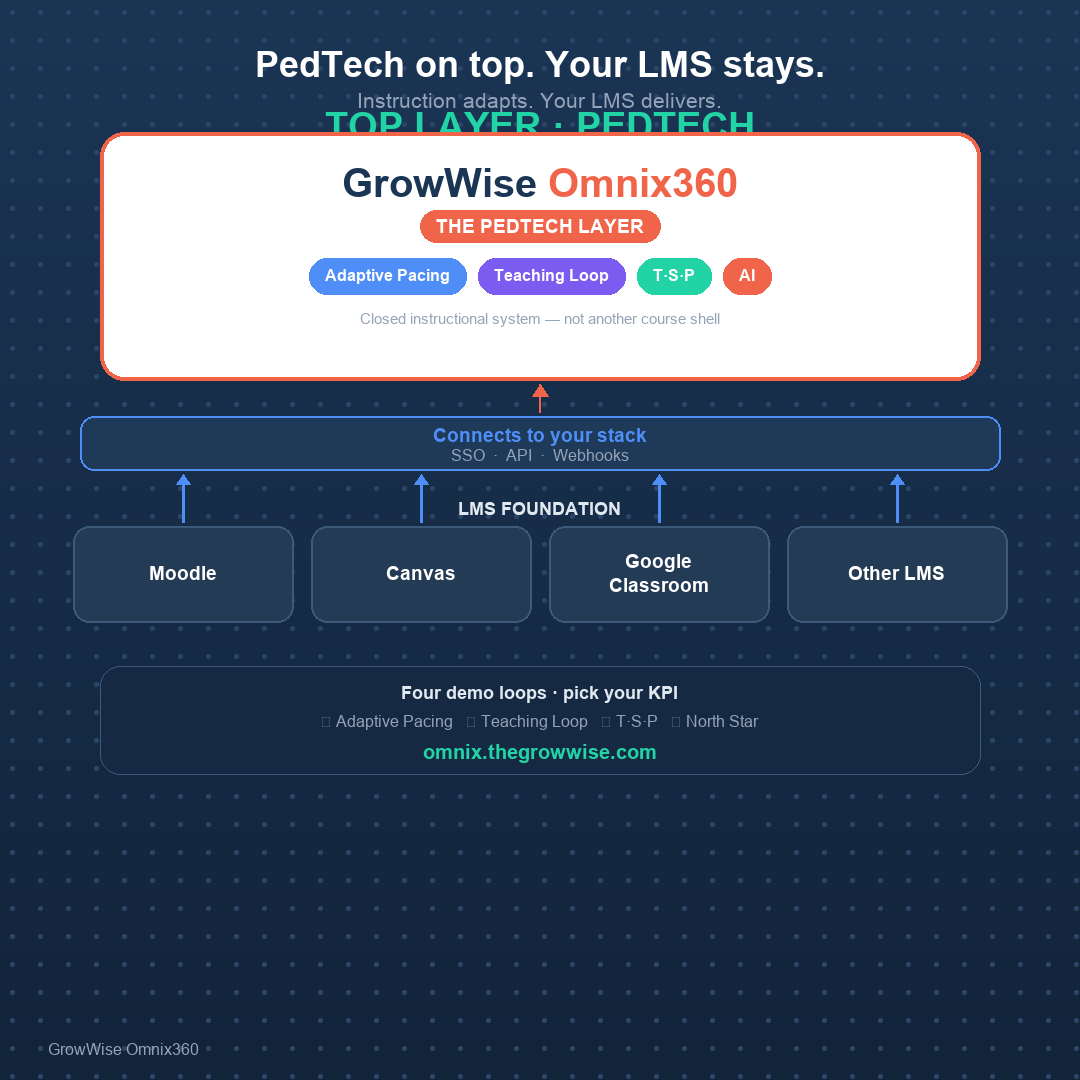
Illustrative only. Your workspace reflects your curriculum and roster.
Related reading
- LMS vs instructional intelligence
- How to track curriculum pacing across tutors and locations
- How AI can support tutors without becoming a student chatbot
- How to choose an instructional intelligence platform
Compare features, review security, or book a live demo.
Frequently asked questions
- What is tutoring management software?
- Tutoring management software usually covers scheduling, billing, CRM, and sometimes session notes. It helps run the business day to day but may not show pacing alignment or topic-level mastery across tutors.
- Do I need an LMS for my tutoring center?
- You need an LMS if hosted content, assignments, and grade storage are your main gaps. You still need something else if your problem is inconsistent delivery across tutors and locations.
- What does instructional intelligence add for tutoring businesses?
- Instructional intelligence connects curriculum pacing, assessment evidence, and early risk signals so directors can manage teaching quality at scale, not just operations and files.
- Can one platform replace all three categories?
- Some platforms span multiple layers, but few do all three well. Evaluate whether the vendor's core strength matches your primary bottleneck: operations, content, or instructional consistency.
Ready to prove pacing alignment in one program?
Start with the pilot playbook, then scope one program with our team, pricing comes after the scorecard.